
It Takes a Village to Thrive: Why We need Human Connection now more than ever
It Takes a Village to Thrive: Why We need Human Connection now more than ever
It takes a village and why we need each other is always something I have deeply subscribed to, and it has never been clearer to me than in the last few weeks. I watched a village gather, quietly and generously, around my daughter’s Class 8 school play. It reminded me how much we need one another: to raise our children, to survive, to be held, and to belong. At home and at work.
The Price of not having a Village
Isolation Is Not Just Lonely. It Is Harmful.
In June 2025, the World Health Organization’s Commission on Social Connection reported that around 1 in 6 people worldwide experience loneliness, linked to an estimated 871,000 deaths a year — about 100 every hour. Loneliness was highest among young people aged 13 to 29, especially teenagers: the very age our Class 8s are stepping into.
In 2023 the US Surgeon General called loneliness an epidemic. The decline in time spent with friends is starkest for young people, down nearly 70% over the last couple of decades.
A widely cited 2010 review of 148 studies by Holt-Lunstad and colleagues found that people with stronger social relationships had a 50% greater likelihood of survival, an effect comparable with well-established risk factors such as smoking.
Connection is not a luxury. It is a basic human need.
The Village Witnessed
The Michael Mount Waldorf Class 8s are performing their final primary school play this week. It is the last thing they will do together before their guardian, who has walked with them for eight years, releases them over the threshold into high school. At a Waldorf school, the children have the same Guardian teacher from Class 1 to Class 8. For their sense of safety, containment and consistency. How beautiful is that?
What struck me was not just the play itself, but everything happening within and around it coming into being.
•Every prop supplied by parents.
•The children’s commitment to practicing every day and sometimes until 6pm. New friends amongst them made in the process.
•Parents preparing the food platters for both nights.
•Our class rep Dad and Mom decorating foyer.
•Maia performing a silk routine in the circus scene, and her head coach from Twisted Cirque, Gerard Hung, coming in to do the rigging so she is safe in the air.
and the school offering to display his business cards in the foyer.
·Together, the class is preparing a farewell gift for their guardian and it is so appropriate that it is a hand-sewn quilt: many hands, many pieces, one whole.
Nobody was asked to do it all. Everyone brought something, and so nothing was missing. That is what a village looks like: a hundred small gestures, woven together.
What the Old Ways Knew
Here in South Africa we have a word for it: ubuntu. Umuntu ngumuntu ngabantu — a person is a person through other people.
Many indigenous cultures were guided by councils of elders, where decisions were made in circle, drawing on many voices rather than one. Give me a council of wise indigenous women and men over any single figure at the top.
Before money, communities survived through barter: I bring eggs, you bring milk. Value moved in both directions, and the relationship grew stronger each time.
Reciprocity in Everyday Life
As a co-parenting mom, I know the village best in the ordinary moments: the parent who fetches your child when you are stuck or tired, the friend who drops off a home-cooked meal when the flu has the family down. Energy exchange. The kind man at the car repair shop (when your brake pads have failed) who calls you an Uber, opens the door for you and tells the driver to keep you safe. Not keeping score but keeping the flow alive.
A healthy village is one where giving and receiving move freely in both directions.
The Village at Work: Why Teams Need Each Other Too
The same truth holds in the workplace. No leader reaches a goal alone, and no team performs well when people work in silos.
High-performing teams work like a village:
•They know each other’s strengths. When people understand who the planner is, the connector, the problem-solver or the safety net, work lands with the person best placed to do it.
•They exchange skill and energy. One person’s eye for detail covers another’s blind spot. One person’s drive and optimism lifts another’s low day.
•They ask for help early. Isolation at work looks like silent overwhelm, duplicated effort and missed deadlines.
When team members see their differences as complementary rather than competing, tension turns into trust, and goals are reached together.
The Village Within: Enneagram Types as Village Archetypes
When I look at the nine Enneagram types, I see the roles of a village and of a team. This is my own lens, not a formal Enneagram system, but it shows why every one of us is needed.
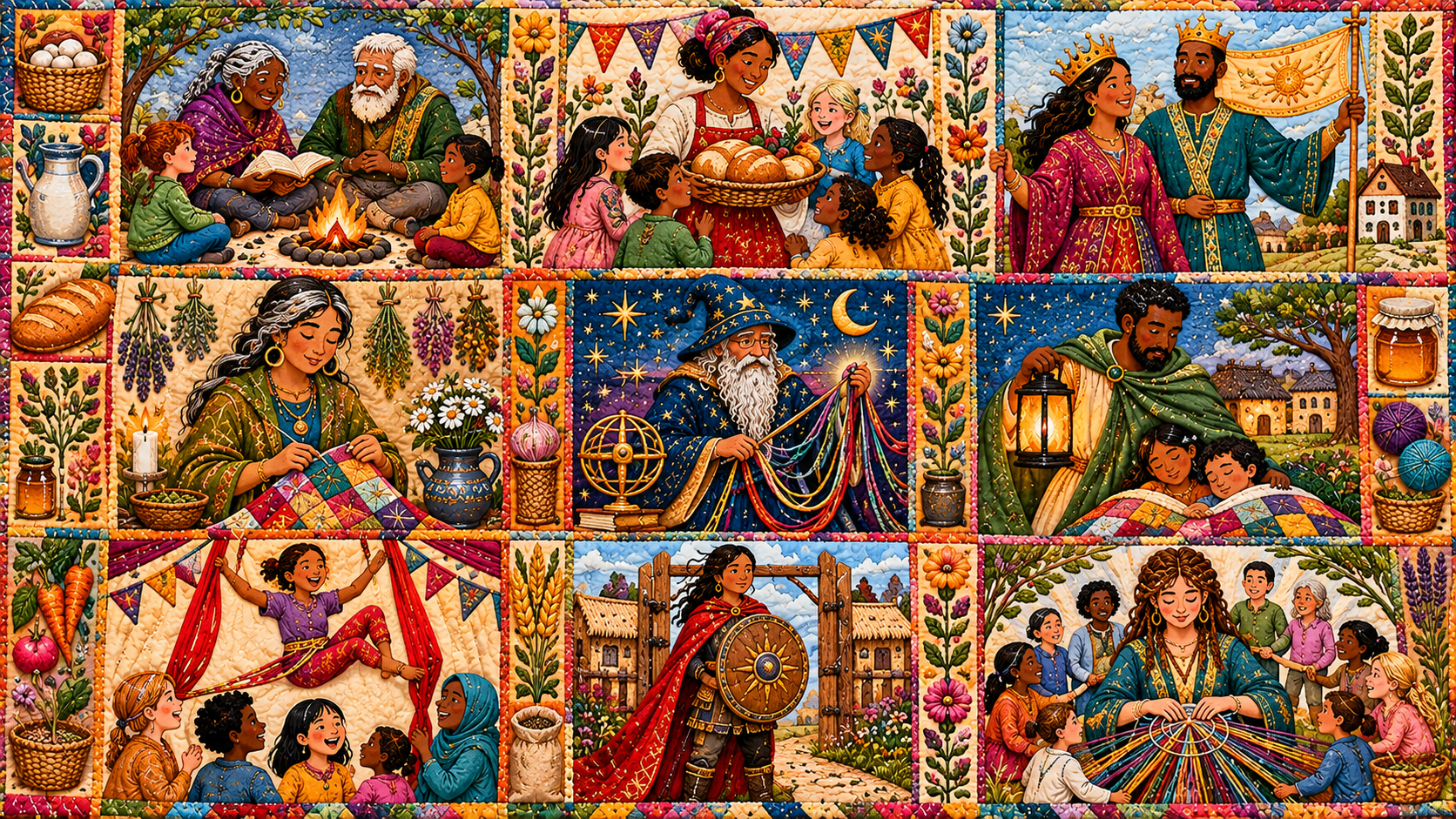
Type 1, The Reformer — The Elder
Brings integrity and keeps the village honest. Isolated, becomes rigid and critical.
Type 2, The Helper — The Mother
Notices who is hungry, tired or in need. Isolated, gives until empty.
Type 3, The Achiever — The Leader (The King and The Queen)
Brings vision and rallies people around a goal. Isolated, measures worth by performance alone.
Type 4, The Individualist — The Medicine Woman
Honours depth, beauty and thresholds, like a quilt stitched for a beloved teacher. Isolated, feels unseen and withdraws.
Type 5, The Investigator — The Merlin
Brings expertise, like knowing exactly how to rig the silks so a child can fly safely. Isolated, retreats into the mind.
Type 6, The Loyalist — The Father (The Guardian)
Brings loyalty and protection, scanning for risk so everyone is safe. Isolated, anxiety grows unchecked.
Type 7, The Enthusiast — The Child
Brings joy, play and possibility. As a 7, I know this one well. Isolated, runs from pain into the next distraction.
Type 8, The Challenger — The Warrior
Brings strength and protects the vulnerable. Isolated, guards the heart so no one can help.
Type 9, The Peacemaker — The Gatherer
Weaves everyone into one circle. Isolated, loses touch with their own voice.
Every Archetype Needs the Others
No single archetype can hold a village, or a team, alone. A play comes together because the Nurturer brings food, the Guardian checks the rigging, the Gatherer decorates the foyer, the Quiet Specialist coaches and guides the children through their scripts and words, the Medicine Woman stitches the quilt and the children express their creativity, play and voice and learn accountability for themselves and each other.
A team reaches its goals the same way: each person bringing their strength, and trusting others with theirs.
We are not meant to be complete on our own. We are meant to be complete together.
Which archetype do you bring to your village, or your team and who has been holding you lately?
Share your answer in the comments or reach out and tell someone in your village that you see them.
If you would like to understand the archetype you hold and provide, explore more here
•Enneagram reflection: https://empoweredinsight.co.za/individual-insight-Discover-and-Align
Read more on LinkedIn: https://www.linkedin.com/pulse/takes-village-thrive-why-we-human-connection-8dzwc
Sources:
WHO Commission on Social Connection, From loneliness to social connection (June 2025) — https://www.who.int/news/item/30-06-2025-social-connection-linked-to-improved-heath-and-reduced-risk-of-early-death
Holt-Lunstad, Smith & Layton (2010), Social Relationships and Mortality Risk: A Meta-analytic Review, PLoS Medicine — https://doi.org/10.1371/journal.pmed.1000316