
Breaking Free: Transcending the Box with the Enneagram
Breaking Free: Transcending the Box
Why the Enneagram doesn't put you in a box, and how it shows you the way out of the one you're already in
We spend so much of our lives trying to fit into boxes. The good child. The reliable one. The strong leader who never drops the ball. The parent who holds it all together. And somewhere along the way, the box stops feeling like something we climbed into and starts feeling like who we are.
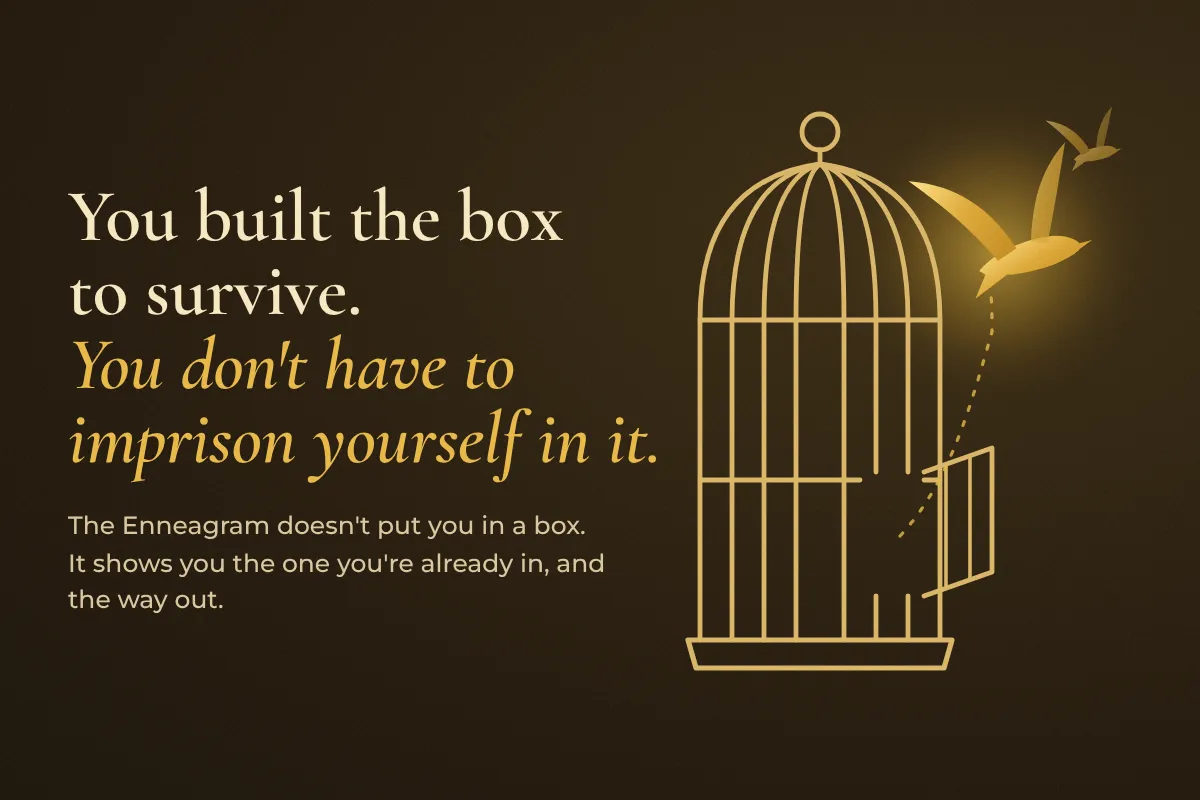
People often ask me whether the Enneagram is "just another personality box". My answer is always the same: it's the opposite. The Enneagram doesn't put you in a box. It shows you the one you're already in, the one you built to survive, and how to step out of it.
The Box We Built to Survive
Long before we had words for it, each of us developed a way of being in the world. Through nature and nurture, we learnt what kept us safe, what earned us love and what gave us a sense of control. Some of us learnt to be helpful. Some learnt to be strong. Some learnt to keep the peace, to get it right, or to keep moving so we never had to sit with the hard stuff.
Over time these strategies became automatic. They became the four walls of a box made of habit, belief and reaction.
Here's what I want you to hear: the box isn't bad. It got you here. It was a clever, creative response to what you faced. The trouble is that a strategy that once protected us can quietly begin to limit us, in our relationships, in our leadership and in how we meet pressure.
Same Behaviour, Different Reasons
Two people stay late at the office. One needs to get it right. One doesn't want to let the team down. Another is afraid of looking incompetent. Same behaviour, three very different motivations, and three very different boxes.
This is why the Enneagram looks at what drives you, not just what you do. It's also why nobody can really guess their own type from a list of behaviours or a free online quiz. A quiz gives you a label. It rarely shows you the walls, or the door.
How the Box Shows Up: Head, Heart and Gut
We all have three centres of intelligence: the head (thinking), the heart (feeling) and the gut (action). We use all three, just in a different order, and under pressure that order becomes our default script.
Let me share mine. I'm a Type 7, the Enthusiastic Visionary. I'm feeling first, action second and thinking last (ask my family!). When something unexpected happens, I feel it, I'm already moving, and the thinking arrives a little later than it should.
My box has a lovely view. Optimism, possibility, the next exciting idea. But it also has a back door I know very well. When things get painful, heavy or simply boring, I'm already off chasing the next new thing, sometimes leaving things unfinished. That's my development pathway: learning to stay, to ground myself and to finish what I start.
Seeing that didn't shrink me. It freed me. Because a pattern you can see is a pattern you can choose differently.
From Vice to Virtue: The Way Out
This is where the Enneagram becomes a portal rather than a label. Each type carries a vice, not as a moral judgment but as a habit of the heart, and a virtue it can grow towards. For my type, the pull is towards more: more experiences, more options, more stimulation. The virtue is sobriety, being fully present with what is, right here, right now.
And the map doesn't stop there. The Enneagram shows you:
Your wings, the neighbouring archetypes you can lean on for balance and support.
Your stretch line, what you can practise to grow when you have capacity.
Your release line, what helps you let go of stress when you're under pressure.
Your levels of integration, showing you where you are on the journey from reacting to responding.
Transcending the box isn't about becoming a different number. It's about becoming more fully yourself, with access to all of who you are, not just the part that learnt to survive.
Why This Matters More Than Ever
We are living in extraordinary times. AI can write the report, draft the email and analyse the data in seconds. But it cannot notice the moment you go into reaction. It cannot feel the tightness in your chest before a difficult conversation, or choose compassion over control when your team is under pressure.
That is the human advantage. Self-awareness, emotional intelligence and the ability to respond rather than react are what build trust, strengthen teams and create real productivity. When leaders step out of their boxes, they give their people permission to do the same.
A Closing Reflection
Take a quiet moment with these questions:
What box did I build to keep myself safe, loved or in control?
Which wall feels tightest right now, at work, at home or within myself?
What might become possible if I stepped out, even for one conversation?
The walls were never meant to be permanent. They were scaffolding for a younger version of you. Seeing your box is the first step to deeper self-awareness. Choosing to step beyond it is where transformation begins.
Are You Ready to Explore Yourself?
If something in this article stirred something in you, I'd love to walk this journey with you. Through an iEQ9 Enneagram assessment and a 90-minute personal debrief, we'll explore your core motivations, your gifts and blind spots, your vice and virtue, and the practical pathways that help you stretch and release, so you can move through life and leadership with more choice and less reaction.
Sessions are available in person at my office in Lonehill or online, for individuals, leaders and teams. My awareness special is available until 18 October. Book yours at empoweredinsight.co.za/awareness-offer.
To learn more about my work with individuals, leaders and teams, visit empoweredinsight.co.za.