
Embodied Intuition
Embodied Intuition Awakened
A sacred path of intuitive awakening—where channelled insight meets practical development for your highest potential. This is a skill that AI cannot replace.
Embodied Intuition
The White Lotus Journey: Embodied Intuition Awakened
A sacred path of intuitive awakening—where channelled insight meets practical development for your highest potential. This is a skill that AI cannot replace.
What is Embodied Intuition?
Embodied Intuition is the art of bringing your inner knowing fully online—anchoring it not only in thought, but in body, spirit, and daily living. In a world that moves at lightning speed, intuition becomes a compass for remembrance, wholeness, and sovereignty. It is not a skill that technology or AI can replicate; it is a living, breathing connection to your deepest truth.
Empowered inSight Offers
Explore intuitive guidance and personal development experiences designed to support clarity, energetic alignment, self-trust, and deeper connection with your inner wisdom.
30 Minute
Reading
A focused session for up to two questions. Ideal for quick clarity, practical insight, or a deeper look into one specific situation needing guidance.
60 Minute
Reading
An expanded session for up to four questions. Suitable for exploring several life areas or one deeper question with more detail and intuitive perspective.
Animal
Companion Readings
Honour the wisdom of your animal companions through messages of love, healing, and understanding that strengthen the energetic bond between you.
The White
Lotus Journey
A one on one intuitive development pathway that helps you awaken your intuitive voice, trust your inner compass, and live with greater clarity.
What is Embodied Intuition?

Embodied Intuition is the art of bringing your inner knowing fully online—anchoring it not only in thought, but in body, spirit, and daily living. In a world that moves at lightning speed, intuition becomes a compass for remembrance, wholeness, and sovereignty. It is not a skill that technology or AI can replicate; it is a living, breathing connection to your deepest truth.
Empowered
inSight Offers
Explore intuitive guidance and personal development experiences designed to support clarity, energetic alignment, self-trust, and deeper connection with your inner wisdom.
Channeled
Intuitive Readings
Receive sacred intuitive guidance that brings through insight, energetic clarity, and multidimensional perspective for career, relationships, life questions, and personal direction.
30 Minute
Reading
A focused session for up to two questions. Ideal for quick clarity, practical insight, or a deeper look into one specific situation needing guidance.
60 Minute
Reading
An expanded session for up to four questions. Suitable for exploring several life areas or one deeper question with more detail and intuitive perspective.
Animal
Companion Readings
Honour the wisdom of your animal companions through messages of love, healing, and understanding that strengthen the energetic bond between you.
The White
Lotus Journey
A one on one intuitive development pathway that helps you awaken your intuitive voice, trust your inner compass, and live with greater clarity.
Embodied
Intuitive Growth
Develop grounded practices that help you integrate intuition into daily choices, relationships, creativity, resilience, and whole living.
Add a Title Here
Add Subtext text. Click "Edit Text" to update the font, size and more.
To change and reuse text themes, go to Site Styles.
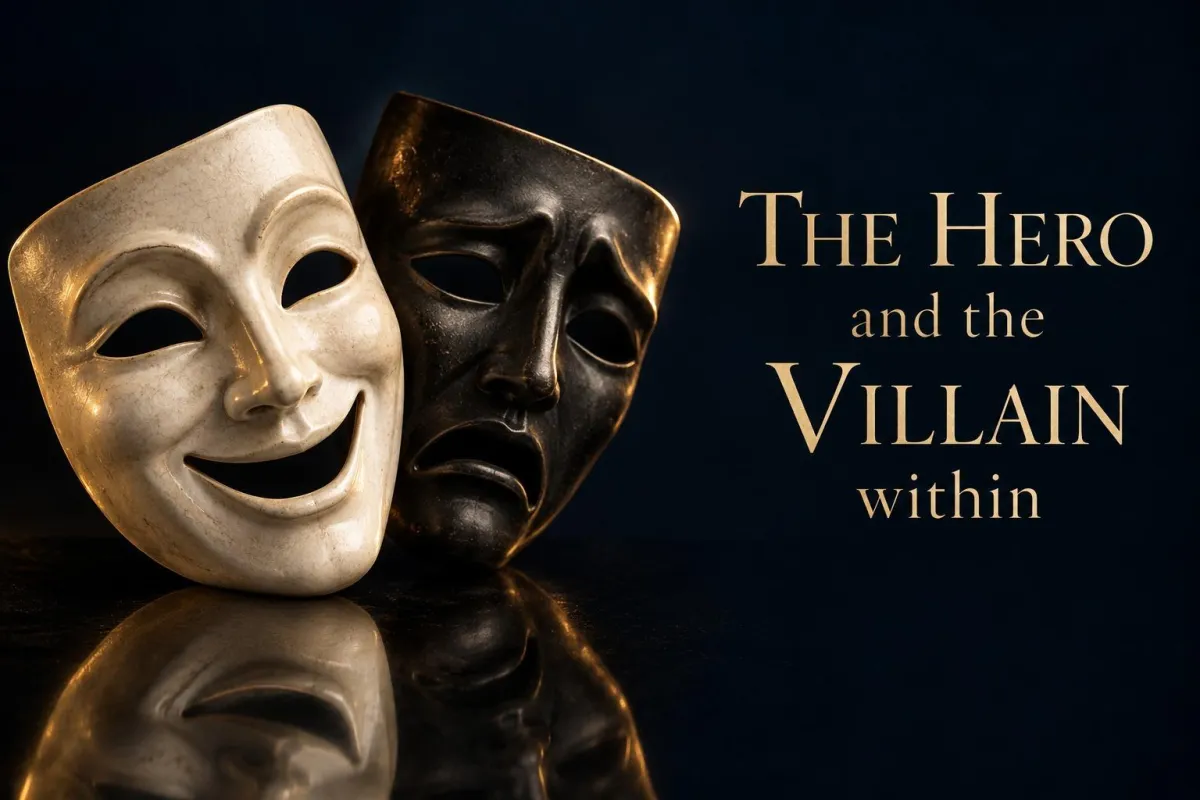
The Hero and the Villain Within: Slytherin Mirrors Gryffindor
The Hero and The Villain Within Each of Us
Slytherin Mirrors Gryffindor
Every year, thousands of readers sort themselves into Hogwarts houses as though the outcome reveals something fixed about who they are. Gryffindor or Slytherin, brave or cunning, hero or villain. But the story itself refuses that split. The Sorting Hat wanted to place Harry Potter in Slytherin. His wand shares a core with Voldemort's. He speaks Parseltongue, a gift no other hero in the story carries. Harry does not defeat “he who shall not be named” by rejecting the Slytherin in him. He defeats him by finally understanding it is already there.
This is the antithesis at the centre of the whole series, and at the centre of most inner work: the tension between the part of us we are praised for and the part of us we were taught to fear. A house is not a life sentence. It is a mirror. And what Harry's story shows, session after session, book after book, is that the mirror cannot be looked away from forever.
Before the hero can integrate, the shadow has to be seen — named, owned, and brought into the same room as the light.
Gryffindor as the Persona, Slytherin as the Shadow
In Jungian terms, Gryffindor is close to what Jung called the persona — the face we present, the identity we are rewarded for. Brave. Loyal. Good. It is not false, but it is partial. Slytherin, in Harry's story and in most people's inner lives, sits closer to the shadow: ambition, cunning, self-preservation, the will to survive by whatever means necessary. Not evil. Simply unwelcome at the dinner table of who we have decided we are allowed to be.
Harry spends most of his early years insisting he is nothing like Voldemort, that the resemblance is coincidence, that the Hat made a mistake even considering it. That insistence is the persona defending its territory. It is also, quietly, the reason he keeps almost losing. A shadow that is only resisted does not weaken. It waits, and it leaks out sideways — in his temper, in his isolation, in the moments he acts from fear rather than choice.
Why Choosing a Side Doesn't Work
This is the part of the story that is rarely spoken about plainly: the belief that becoming more Gryffindor — braver, purer, more certain — is what will finally close the gap between Harry and the darkness he fears becoming.
It doesn't. Bravery without cunning gets people killed. Loyalty without discernment gets people used. The characters who survive and grow across the series are rarely the purest Gryffindors — they are the ones who learn to borrow from the house they were never sorted into. Hermione's rule-bending. Ron's strategic mind. Even Dumbledore, the story's wisest figure, is written as someone who understood ambition intimately enough to recognise it, and to choose otherwise.
Can a hero win a war using only the qualities he is comfortable with? This is not a failure of courage. It is a mismatch between the part of the self we are taught to lead with — the persona — and the fuller self actually required to meet the moment.
The Enneagram Connection
The Enneagram offers a map for why this split shows up differently for each of us, because every type carries its own version of a favoured house and a disowned one.
A Type 1, the Reformer, may lead with Gryffindor-like conviction and rightness — and disown the Slytherin capacity to bend a rule strategically when the rule no longer serves the outcome. A Type 2, the Helper, may lead with loyalty and self-sacrifice, and struggle to access the ambition that would let them ask directly for what they want. Each type has a house it wears proudly, and a house it exiles.
These exiles are rarely random. They often trace back to a moment when the disowned quality was punished, shamed, or made to feel dangerous — ambition read as arrogance, cunning read as dishonesty, self-protection read as selfishness. This is where Body Emotion Code sessions become relevant: releasing the trapped emotional charge that keeps a quality locked away in shadow long after the original threat has passed.
Integration as the Only Way Through
It is tempting to read Harry and Voldemort as a story about good defeating evil. It is more accurate, and more useful, to read it as a story about integration defeating fragmentation. Voldemort is what happens when the shadow is never met, never owned, and allowed to run the whole self unchecked. Harry survives because, again and again, he is willing to look at the part of himself that frightens him instead of severing it.
Gryffindor and Slytherin are not enemies competing for the throne of who you really are. They are two ends of the same self, and the discomfort of holding both is often exactly where the growth begins. Rather than resisting the parts of yourself that feel too ambitious, too guarded, or too strategic to be “good,” the invitation is to become curious about what they have been protecting all along.
To embrace your Slytherin is not to abandon your Gryffindor. It is to stop asking one half of yourself to fight the war alone.
Integrating the disowned house is not a mindset shift. It is a practice.
•Nervous system regulation — noticing what happens in the body the moment ambition, competitiveness, or self-protection rise, rather than immediately shutting them down as “not who I am.” https://empoweredinsight.co.za/individual-insight-Decode-and-Heal
•Enneagram reflection — identifying your own favoured house and your own exiled one: which qualities do you lead with, and which do you quietly judge in yourself or others? https://empoweredinsight.co.za/individual-insight-Discover-and-Align
•Emotion release work — finding the moment the disowned quality was first shamed, and releasing the charge so it can be reclaimed as a resource rather than kept in exile. https://empoweredinsight.co.za/individual-insight-Decode-and-Heal
These aren't separate from the courage everyone can already see in you. They're what makes the rest of you available too.
My Approach at Individual inSight
My background blends an understanding of systems and process with accreditation in the Enneagram, Coaching and Body Emotion Code, nervous system-informed emotional work. What I've seen, again and again — including in a session just yesterday, where a client recognised themselves in exactly this story — is that the parts of us we've exiled don't disappear. They wait, quietly shaping our choices from the shadows, until we're willing to bring them back into the room.
At Individual inSight, my work isn't to convince you to be braver, or kinder, or more disciplined. It's to help you notice which house you've been defending, what it cost you to disown the other one, and where trapped emotion may be keeping that exile in place long after it stopped protecting you. If this is landing, I'd love to support you — through a Body Emotion Code session, an Enneagram reading, or simply a conversation about the part of yourself you've been keeping at arm's length.
Closing Reflection
Gryffindor shows you who you're proud to be. Slytherin shows you what you've been protecting yourself from admitting.
Which house have you been defending — and which one have you exiled?
If a part of this feels familiar, it is worth sitting with rather than pushing past. Reflect on it, respond in the comments, or share your own moment of meeting the part of yourself the Sorting Hat saw before you did.

Discover Your Authentic Self with Empowered InSight

Return to
Your Self
Reconnect with the self beneath conditioning, trauma, and the need for external validation. This work invites you back to your authentic nature, where clarity, truth, and deeper alignment can begin to emerge.

Guided Transformation
Transformation is rarely easy, and no one is meant to walk it alone. Sarika offers a grounded, non judgmental space where each session is tailored to your unique path, needs, and unfolding process.

The White Lotus Journey
The white lotus reflects the journey of growing through lived experience, unconscious patterns, and emotional pain. With care and intention, this path can lead to joy, alignment, abundance, integrity, and true potential.
Scientific Angles on Intuition
Intuition is not simply mystical guesswork. It can also be understood as a rapid, non-conscious process shaped by pattern recognition, embodied signals, memory, and lived experience.
Understanding Intuition Through Science
Scientifically, intuition is increasingly understood as a fast, non-conscious cognitive process that draws on accumulated experience, subconscious memory, bodily cues, and neurodynamic processing. Rather than replacing logic, intuition often works alongside it, helping the mind and body recognise patterns before those patterns can be fully explained through conscious reasoning.
Neurobiological Foundations
Intuition arises through rapid brain-based processing, where neural networks integrate sensory input, memory, emotional signals, and prior experience. This can create what many people experience as a hunch, inner knowing, or immediate sense of direction before a full rational explanation is available.
Pattern Recognition
Intuition is strongly connected to the brain’s ability to recognise patterns without deliberate analysis. Experienced professionals, such as doctors, pilots, leaders, and specialists, often rely on intuitive judgement because their minds have absorbed thousands of subtle cues through repeated exposure and practice.
Gut Feelings and Embodiment
The phrase “gut feeling” reflects the connection between the body and decision-making. Signals from the nervous system, including the gut-brain connection and vagus nerve pathways, can influence how people sense risk, safety, alignment, or uncertainty. This helps explain why intuition is often felt physically, not only mentally.
Speed and Logic
Intuition often operates faster than step-by-step reasoning. It can be especially valuable in uncertain, complex, or time-sensitive situations where conscious analysis alone may be too slow. When developed responsibly, intuition can support clearer choices, stronger self-trust, and more integrated decision-making.
Frequently Asked Questions
Is there science behind intuition or clairvoyance?
Yes. While intuition is often described as “gut feeling” or “inner knowing,” neuroscience shows that the brain processes vast amounts of information unconsciously. This means intuitive insights are often the result of subtle pattern recognition, memory, and emotional intelligence working together. Many studies on the gut-brain axis, neuroplasticity, and subconscious processing support the idea that intuition is a natural human capability, even if the language of “downloads” or “clairvoyance” is more spiritual.
Does intuitive development go against my religious beliefs?
Not at all. Intuition is a universal human capacity—it doesn’t belong to any one religion or belief system. Developing intuition is about deepening your connection to yourself and your source of wisdom. Many people find it complements their faith, helping them listen more clearly to divine guidance, prayer, or inner truth.
Is intuition only for gifted people?
No. Intuition is innate in everyone. Some people may appear more “psychic” because they’ve practiced tuning into subtle signals, but just like a muscle, intuition strengthens with attention and training. The White Lotus Journey is designed to help anyone cultivate their intuitive gifts, whether you’re starting fresh or refining existing abilities.
Can everyone become “psychic”?
Yes although “psychic” is simply another word for heightened intuitive awareness. Everyone has the capacity to sense, feel, and know beyond logic. With practice, guidance, and embodied techniques, you can learn to trust your inner downloads and integrate them into daily life. It’s less about becoming someone else and more about remembering the wisdom you already carry.
“The intuitive mind is a sacred gift and the rational mind is a faithful servant. We have created a society that honors the servant and has forgotten the gift.”
–
Albert Einstein
“The intuitive mind is a sacred gift and the rational mind is a faithful servant. We have created a society that honors the servant and has forgotten the gift.”
–
Albert Einstein
Empowered inSight
Where Science meets Soul to awaken
lasting transformation.
Connect with us
Discover Your Authentic Self with
Empowered InSight.


© Copyright 2026. EMPOWERED INSIGHT .
All rights reserved.
Privacy Policy